

News
Jorina Baars: ‘Working with this group challenges me too’
The sport-wide campaign Onze Club Is Voor Iedereen (Our Club Is For Everyone) draws attention to diversity and inclusion. Perhaps somewhat fashionable terms, but it simply comes down to everyone being welcome. Combat sports have traditionally been very colourful, including in terms of the backgrounds of the participants. Even so, there are still opportunities to get new groups over the threshold. Fighters with a physical or mental disability, for instance. In this series we highlight a number of gyms that may inspire others to appeal to a wider audience as well.
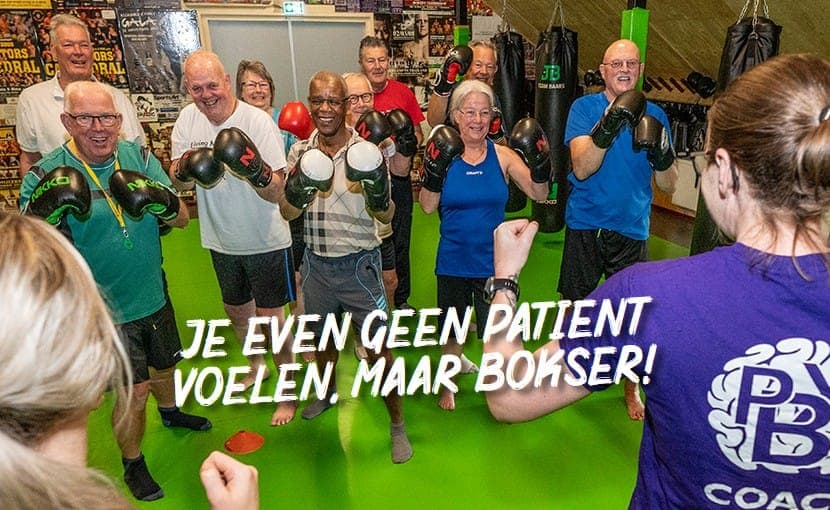
SportsArt Den Helder, run by kickboxing and muay thai phenomenon Jorina Baars, is an ‘ordinary’ gym where everyone is welcome to train at their own level. But SportsArt also offers special classes for a particular group of athletes. On Monday mornings and Thursday evenings she has a group on the mat with an extra challenge: Parkinson's disease.
Combat sports are already complex for the average athlete. What is that like for people with Parkinson's?
“In combat sports you have to keep your balance, distribute your energy well, keep your guard up, read your opponent and land attacks. Even in its most basic form, boxing is already a dual task: you have to step and strike at the same time. Parkinson's disease makes it precisely more difficult to combine different tasks. But training that gives patients exactly the practice they need. Scientific research shows that boxing slows down the progression of the disease.”
How did you come up with the idea of offering Parkinson Boxing?
“My neighbour, who has the disease, pointed me to an article about a study showing that boxing has a slowing effect on the progression of Parkinson's. And later that day Danique de Klein, who became my partner in this project, came to me with the same article. That is how the idea of offering training sessions came about.”
Where did you get the knowledge to be able to do this?
“Danique works as a case manager at Geriant, an organisation for people dealing with memory problems and dementia. She regularly teaches kickboxing or punchbag classes at SportsArt. Together we completed the Parkinson Boxing course successfully. Parkinson Boxing is supported by ParkinsonNet. We are also in contact with a physiotherapist specialised in Parkinson's. We keep learning after the course as well. For example, I also took a continuing education course for nurses about Parkinson's.”
Isn't it risky to have people with health problems practise a combat sport?
“We do Parkinson boxing without real contact. We only strike each other's boxing gloves or the punchbag. Certainly not to the head. We design the training sessions very much with this group in mind, to keep the training as safe as possible. It is in fact much more than just training with boxing gloves on. We also do circuits, exercises with bouncing balls, throwing and catching balls, both left-handed and right-handed. The common thread is always: doing things simultaneously. That could also mean they pass a ball around and each time name a person starting with the next letter of the alphabet: Annie, Bertus, Corrie, Daniel, and so on. That also makes it easier to keep things varied.”
What makes it enjoyable for you as a gym owner and trainer?
“It is a completely different group. It requires a bit more patience, but that way I am challenged to develop myself as well. I could run the same ‘ordinary’ training sessions for thirty years, but with more variety my work naturally stays enjoyable for longer.”
Does this new group change your gym?
“We have always had a very broad audience, literally from 6 to 86 years old. But this group does have its own challenges, and everyone has to take that into account a little. It works well alongside the regular audience. I see that when someone from the Parkinson's group is having a bad day and walks with great difficulty, the competitive kickboxers support him on the way to or from the changing room, or when he has to take the stairs. I think that is a fine thing.”
Is there any support from funds or institutions?
“Unfortunately not yet. I understand that work is being done to have it reimbursed through health insurance, but that is not possible yet. I think that would be a good thing, because it lowers the threshold if the costs are covered.”
Do you have any tips for other combat sports gym owners who want to do something similar?
“If you think you can muster the patience, because that is a requirement, I would certainly give it a try. It adds value to your gym, it is good for the sense of togetherness and the social character of the gym. And by doing this, your gym also has added value for society. And above all for the group itself, who can be an athlete for a while instead of a patient.”
Our club is for everyone
If what is on offer is properly matched to demand, more and more people will find their way to the combat sports gym. In this series of articles we highlight gyms that successfully appeal to new groups and have developed a culture of inclusivity, in the hope that these ‘best practices’ will inspire others. The campaign Onze club is voor iedereen (Our club is for everyone) offers support from NOC*NSF (the Dutch Olympic Committee and Dutch Sports Federation) to clubs, associations and sports entrepreneurs that want to actively work on diversity and inclusion. A menu of options has been developed for this purpose, including free workshops and training programmes.
Earlier in this series: