

News
NRC: A ban on punches and kicks to the head, these combat sports dare to do it
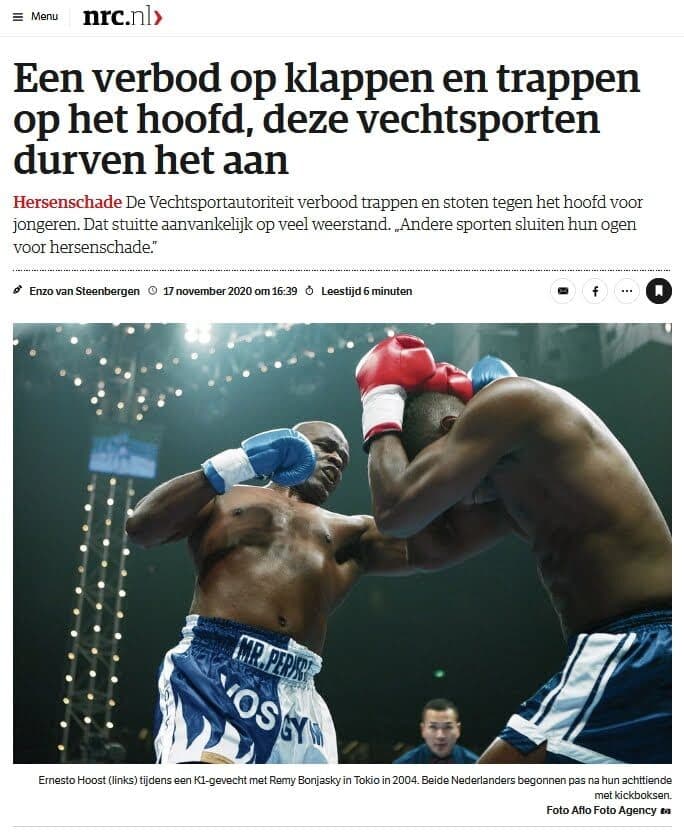
NRC recently published an article about brain damage in athletes, and above all about how sports organisations deal with it. The Combat Sports Authority banned kicks and punches to the head for young athletes. That initially met with a great deal of resistance, explains VA director Farid Gamei. “Other sports close their eyes to brain damage.”
“I only started competing at eighteen and still grew into a multiple world champion. It is questionable whether that would have worked out if I had been taking blows to the head before that.”
Those are the words of Ernesto Hoost, four-time world champion in the combat sport K1. He said it a few years ago, when the Combat Sports Authority announced that from 2020 it would ban kicks and punches to the head for young people under the age of eighteen. That makes the regulator for kickboxing, Thai boxing and mixed martial arts (MMA) the only sports organisation in the Netherlands to have taken such drastic measures against brain damage in athletes. The Combat Sports Authority is convinced that kicks and punches to the head can lead to brain damage, such as speech disorders, confused behaviour or, in the long term, dementia.
Introducing the rule was not easy, those involved say. Competitive athletes in particular feared that the level of the sport would drop. So how did the Combat Sports Authority manage to change three sports completely? Through a carefully considered strategy, gradual change and help from former champions.
Combat sport was not doing well at the start of this century. Combat sports galas regularly got out of hand, there were shootings, and the police saw that the criminal and legitimate worlds were meeting at ringside. Children’s bouts were often poorly supervised as well, and it was sometimes unclear who was monitoring their health. None of it dented the popularity of the sports. Figures from the Combat Sports Authority show that more than 530,000 people practise kickboxing, Thai boxing or MMA.
There were many organisers of bouts and sports galas, all working to different guidelines. That had been the case for decades. Sports umbrella body NOC-NSF and the Ministry of Health, Welfare and Sport wanted the sport to be better regulated, and the talks about that produced the Combat Sports Authority in 2017. It was to ensure ‘clean’ and safe combat sports galas and to improve medical checks in the sport.
Farid Gamei, a former combat athlete (“luckily for my brain I stopped young”), became its director. He says the decision to abolish blows to the head for youth was taken almost immediately.
The medical committee agreed that there were major risks of damage to developing brains. They asked Lot Verburgh, a researcher specialising in the relationship between sport and children’s brains, to carry out a literature review. Verburgh took her doctorate at the Vrije Universiteit in Amsterdam and worked as an adviser to football association KNVB and to Ajax. Together with neuropsychologist Keri Mans she combed through the international scientific literature on the subject.
In their report they write that there is “sufficient scientific evidence that repeated impact on the head can lead to temporary, but also permanent, damage to the brain”. Among the possible consequences they list problems with memory and reaction speed. They also write that research among adult (former) combat athletes shows that half of them have chronic brain damage. Of children they write that the “brain is still very much developing” and that this process “must not be disrupted”.
Bas Pijnenburg, a former ringside doctor and chair of the medical committee at the Combat Sports Authority, says there was no doubt about the decision: “As a doctor I would actually want to set the age limit even higher. Adolescent brains are so sensitive that blows can cause really serious damage. We set the bar at eighteen because that is also the age at which people are legally responsible for their own decisions.”
Once the decision had been taken internally, there was one important question, director Farid Gamei says: “How on earth are we going to do this? We knew the measure would not be popular. And this in a sector where everyone had been able to go their own way for years. It could never happen overnight.”
The board decided to organise a conference at the end of 2017. The main guest was Erik Scherder, the neuropsychologist who became well known through the television programme De Wereld Draait Door. He made clear what blows to the head can do to athletes, and to children. In the room sat all the major organisers of bouts, athletes’ managers and promoters. They knew they could not simply reject the plan: the Combat Sports Authority has the decisive say in granting permits for combat sports galas and bouts. In practice, anyone who does not follow the rules is sidelined.
Also at the conference were Ernesto Hoost (the four-time K1 champion), Remy Bonjasky (three-time winner of the K1 World Grand Prix) and Marloes Coenen (former MMA champion). They had been invited because the board was keen for them to help build support for the ban. They were not chosen at random. All of them are great champions, world famous. But Hoost and Bonjasky in particular had another advantage.
They only took up kickboxing after they turned eighteen. For the Combat Sports Authority they were living proof that the quality of combat sport need not suffer under a ban on kicks and punches to the head for young people. The three athletes agreed to take part and afterwards consistently stressed their own story in the media: even if you start later in life, you can still reach the top of the world.
The age limit was then raised year after year. First came a ban up to the age of sixteen, then up to seventeen, and since the beginning of this year up to eighteen.
What continues to gnaw at Gamei is that the Combat Sports Authority is the only sports organisation in the Netherlands taking measures of this kind. He is often asked: why are we no longer allowed to strike the head while boxers still are? And why is it allowed in taekwondo and not with us? Gamei finds that hard to counter. “We are not responsible for those sports. If we were, we would have introduced a ban long ago,” he says.
The Combat Sports Authority has tried to bring other (combat) sports along, but Farid Gamei feels he is running into a wall. He has shared the scientific study with the Dutch Boxing Association. The Combat Sports Authority has also raised the problem with sports umbrella body NOC NSF, in the hope that it would start working towards a ban on blows to the head in other sports too.
So far that has not happened. In a response, NOC-NSF says it will shortly organise a meeting between sports organisations “to exchange knowledge about the adverse effects of punches, kicks and other impact on the head”.
Read on at the NRC website. Unfortunately it is behind their paywall.
A few days after this article was published, NRC returned to the subject in an editorial:
Associations should want to know what the risks of their sport are
“Meanwhile, attention is growing in other sports too for potential dangers that were previously not regarded as health risks. Anyone who takes up boxing has to be able to take a hit. Blows to the body are part of combat sports, just as heading is part of football, body checks part of ice hockey, and tackles part of rugby and American football.
That may be true, but it does not mean there is no room for improvement. Measures are conceivable, as the Combat Sports Authority demonstrates, that at the very least limit the risks for young people without damaging the soul of the sport.
Perhaps associations fear that they will come into conflict with tradition. But the past must not be an argument for looking away. It starts with recognising that some sports can pose health risks. That is only possible if associations take responsibility and want to know what the potential dangers of their sport are.”