
News
Jan Loorbach steps down: 'Very satisfying to be able to contribute'
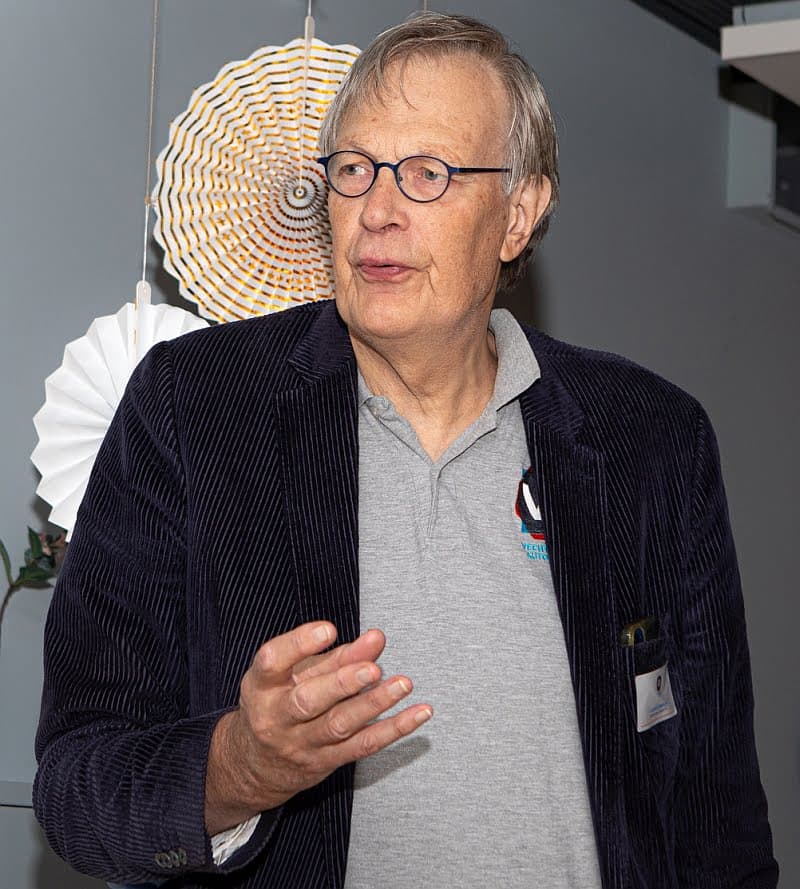
After six years, Jan Loorbach is stepping down as a member of the Supervisory Board (Raad van Toezicht) of the VA. He watched an organisation that initially consisted mainly of good intentions grow into an institution. "We moved very quickly from solving problems to seizing opportunities."
Jan Loorbach has been active in the world of sport for decades. He started out as a basketball player. Anyone who knows his height of 217 cm will not be surprised. He made it to the Dutch national team and became the top scorer of the Eredivisie.
While competing at a high level, he graduated and began working as a lawyer. He eventually also became president (deken) of the Netherlands Bar Association (Nederlandse Orde van Advocaten).
He never let go of sport. He became chairman of the basketball federation, a board member at NOC*NSF (the Dutch Olympic Committee and Sports Confederation) and Chef de Mission of the Olympic delegation to the Sydney Games. We look back on one of his last 'side jobs', his involvement with the VA.
The VA was established in 2017 to lift martial arts out of the doldrums. You have no martial arts background yourself, it is an unpaid position, and someone else would be enjoying their retirement. Why did you still say yes when you were asked to get involved with these problems?
'I have a lot of experience in sports governance, I am a lawyer and an athlete, and that combination apparently makes me interesting. If people approach me about things I am good at and enjoy, I say yes fairly quickly. It is also very satisfying if you can contribute to a good initiative. What is more, in the world of sport you often work with pleasant, positively minded people. They turned out to be present in martial arts as well.'
The model of an independent regulator in sport did not yet exist. The VA had to gain a foothold in a headstrong world without many resources. Why do you think this succeeded?
'It started as an initiative to take martial arts out of the disorder, the fragmentation, the wrong context. I saw opportunities for martial arts to grow in several areas. At the first session, still with the mayor of Amsterdam, Van der Laan, the conversation also moved very quickly from solving problems to seizing opportunities. Why it succeeded: despite a great deal of division, the conviction grew within the sector that there was a shared interest. Promoters and gym owners saw that with a licence or quality mark they could demonstrate that they were not shady operators. With the help of the VA, prejudices could be removed. And municipalities increasingly realised that they were being handed a fine instrument, which is why they too got behind it. The added value that the work of the VA provided for the sector and for municipalities ultimately gave the VA its authority in this world. The fact that this was achieved deserves great credit to the board and the office. Also because they dared to take measures that were initially unpopular, but necessary. Only later, sometimes reluctantly, did recognition follow.'
A Supervisory Board has to keep an organisation on course. What was the biggest challenge?
'As supervisory board members we had a limited task. We regularly reviewed matters, but we were also happy to contribute our thinking. The previous chair, for instance, was closely involved and, from his background as a mayor, regularly looked over our shoulder on governance issues. Continuity of funding was actually the biggest challenge. Making sure the organisation could do its work on a sustainable basis.'
The VA started out in a fragmented sector, with dozens of federations and a great deal of division. We are now seeing the birth of a single martial arts federation. How do you view this?
'I am very curious to see what added value it will bring. Nine existing organisations are merging into it, which is interesting. I think this federation can take up a fine position in the Dutch sports landscape. It offers opportunities for the further development of the sports. The federation will also become eligible for financial support, which means it can do more in the area of training courses, for example. It will also have to take over matters such as disciplinary law and anti-doping work from the VA. But the VA will still be needed for some time to come, as an independent regulator.'
Can other sports now learn something from the VA?
'The VA of course came into being in response to particular societal problems. You see those having less influence in other sports. In that sense, the circumstances of different sports are difficult to compare. But the Minister for Sport has indicated that it would be good if federations were sometimes reviewed from outside the federation structure, because in some matters it is difficult for a federation to assess its own conduct. Consideration is being given to an integrity centre, and the experiences of the VA could be useful for that.'
What advice would you like to pass on to Dutch martial arts for the future?
'Safeguard your reliability and credibility as a sector. The federation and the VA operate in a world of strong competition, both in sporting and in business terms. So what you do in one case is immediately compared with what you do in another. Be very transparent and consistent, because that strengthens support for what you are all doing together.'
Jan Loorbach officially steps down on 1 January 2024. He has since been succeeded by Rob van Bokhoven, Director of International Affairs at the Repatriation and Departure Service (Dienst Terugkeer & Vertrek) of the Ministry of Justice and Security (ministerie van Justitie en Veiligheid).