

News
Interview with VA chair Dekkers: ‘Safety is a precondition for the future of martial arts’
Five years ago this month, the Nederlandse Vechtsportautoriteit (the Dutch combat sports regulator, VA) began its work. On this first anniversary, VA chair Herbert Dekkers looks back and ahead in two conversations. This first part of the two-part series focuses on safety. “People sometimes forget how badly the sport was doing. I think we can conclude that the sector saved itself from collapse. But that rescue is not final; it requires work every single day, and from everyone.”
It was not so long ago that combat sports only received media attention when yet another event had got out of hand. Fights, even shootings, the intimidating presence of motorcycle gangs and known criminals: many municipalities would rather see combat sports go than come. “Mayor Van der Laan of Amsterdam had had enough and wanted to ban combat sports events in the capital for good,” Herbert Dekkers recalls. He has been chair of the VA since its establishment. “A ban in Amsterdam would undoubtedly have led to a snowball effect. Many municipalities would have followed. That would probably have been the death blow for Dutch combat sports. Because where are you as a sport if you cannot organise competitions? The thousands of young people who now compete would probably have chosen a different sport. How could the new generation of elite athletes then have grown to their current level? Without a solid base you have nothing. Events are the foundation on which the entire sport rests.”
“Fortunately, there was that small group of people from the combat sports world who refused to let it happen. Ernesto Hoost and Remy Bonjasky, among others, approached Van der Laan and convinced him to take a different approach. We should not demolish the sector, but renovate it. Not prohibit, but regulate. And fortunately this mayor had the nerve to say: all right, tell me how, show me.”

Peter Aerts, Ernesto Hoost, Remy Bonjasky, Eberhard van der Laan, Sem Schilt, Rico Verhoeven
Dekkers has a background in the police and currently works at the regional environmental agency Omgevingsdienst IJmond. He has crossed paths with dozens of local administrators, which allows him to judge just how exceptional the mayor's decision was. “I think nine out of ten administrators would have said: figure it out yourselves, I'm simply banning it, because if it goes wrong again they will hold me responsible. In that respect Van der Laan really was a gutsy Amsterdammer.”
A steering group was formed, an administrative term for a group of people who want to move in the same direction. Brainstorming sessions were held with people from the combat sports world who were willing to take responsibility. “Working on the future together: that spirit had been missing until then. There were thirteen organisations calling themselves a ‘federation’ and they mainly saw each other as competitors. Was there a disagreement within such an organisation? Then another group would split off and there would be yet another federation. We saw promoters badmouthing each other, gym owners sabotaging each other. Cooperation was rare; people preferred to obstruct one another. Well, try solving the problems you all share under those circumstances.”
Cultural shift
The steering group gave rise to the Vechtsportautoriteit in 2017. Supported by the ministry responsible for sport (ministerie van Sport) and the national sports umbrella organisation NOC*NSF, the organisation was to act as regulator and put combat sports in order. “The assignment was to work towards a regulated, healthy, safe and well-organised combat sports sector. But that would stand or fall on a cultural shift. Forward together: that idea underpins all the measures we have taken in recent years. After five years I can conclude that this cultural shift is genuinely under way. We are seeing more and more cooperation. Federations that used to fight each other tooth and nail now sit down together to solve problems. By making agreements together and sticking to them, they, but also the promoters, the gym owners and the training providers, have shown that the organisation of combat sports in the Netherlands is heading in the right direction. And that was absolutely necessary, given the abuses. I think the sector saved itself from collapse at the very last moment.”
The VA's measures were not always popular. The introduction of the Fightpassport, the conditions for events, a promoter's licence, the requirements of the Keurmerk Vechtsportautoriteit (the VA quality mark for gyms): it sometimes creates extra work that not everyone welcomes. “We realise it is not always pleasant when we set new requirements. But those are sacrifices you have to make together, and above all you have to keep in mind what you get in return. Before 2017, events got out of hand too often. That very often had to do with poor preparation. Yes, as a promoter you now have to jump through a few hoops, but look at the results. In the last ‘normal’ year before the coronavirus crisis, 2019, we had 200 combat sports events in the Netherlands. Not once did things get out of hand. This has also brought about a shift among municipalities. Where they used to think: how do we keep such an event out, promoters are now often welcomed with open arms. Because municipalities know that safety is being taken seriously.”
Hasselt
We recently saw a Glory event get out of hand in Belgium. Many people fear that the riots will set combat sports back in time. “I do not want to pre-empt the investigations into how things went wrong in Hasselt. Belgium does not set the same requirements as the Netherlands, but exactly what role that played is still being analysed. In any case, it underlines how extremely important it is that we all keep working on safety.”
“Whatever the exact cause, an incident like this deters spectators, sponsors and media. There are undoubtedly people who now think: no way am I going to a combat sports event. Or: perhaps my child should take up judo instead of kickboxing after all. That is a great shame. These disturbances harm every hard-working promoter and gym owner in the Netherlands. Municipalities do think twice when they see this. But we also hear from municipalities and from the sector that it makes clear once again how important it is to set requirements and to exercise oversight.”
Responsibility
After such an incident, attention focuses mainly on the promoter. What did they do to prevent things from escalating? But eyes also turn to athletes, who would bear a responsibility for the behaviour of their supporters. Is that fair? “I cannot stress enough that we all have a responsibility. And I do not mean that in the political sense, where you say everyone is responsible so that no one is really responsible. It is genuinely the case that we all have a role. The promoter must organise the event safely. The municipality must set the right requirements. The fighter and the gym must take responsibility for the behaviour of their supporters. They are obliged to do so; as an athlete you sign up to that when you apply for a Fightpassport. If you fail to do so, it can result in a substantial suspension. And a gym that falls short can lose its Keurmerk Vechtsportautoriteit. Its members are then excluded from taking part in events in the Netherlands. But spectators themselves must also realise that they are ambassadors of combat sports. If they behave, combat sports will be welcome everywhere. If they misbehave, they harm their own idols, but also the sport as a whole. No one can sit back, so let us all keep working on safety and therefore on the future of combat sports.”
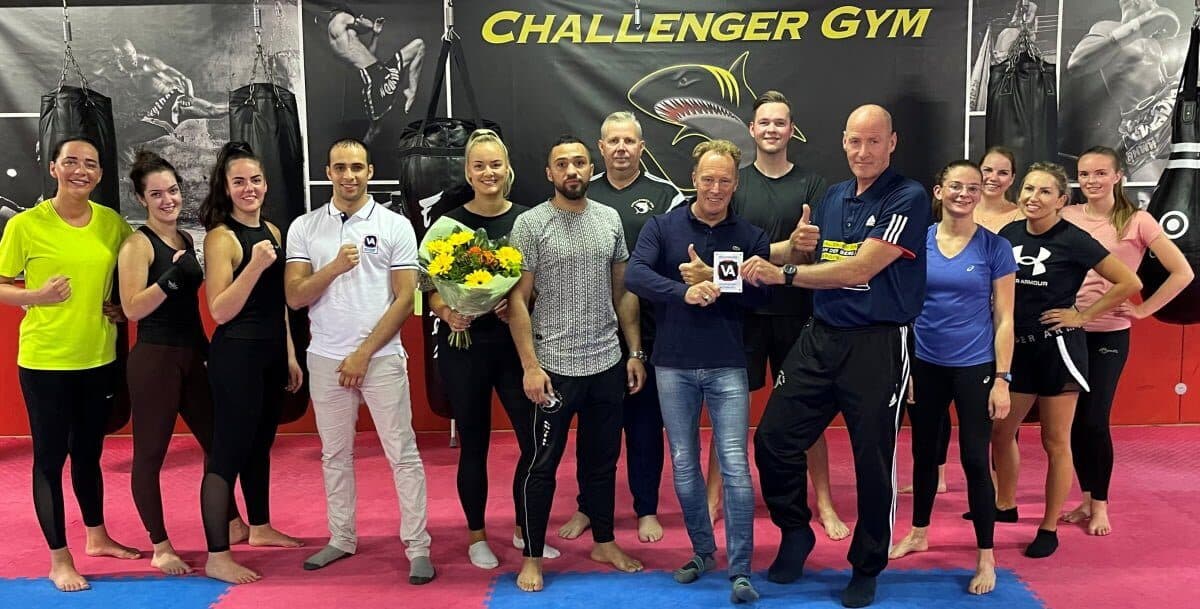
Photo above: Herbert Dekkers presents the Keurmerk Vechtsportautoriteit to Challenger Gym in Urk